
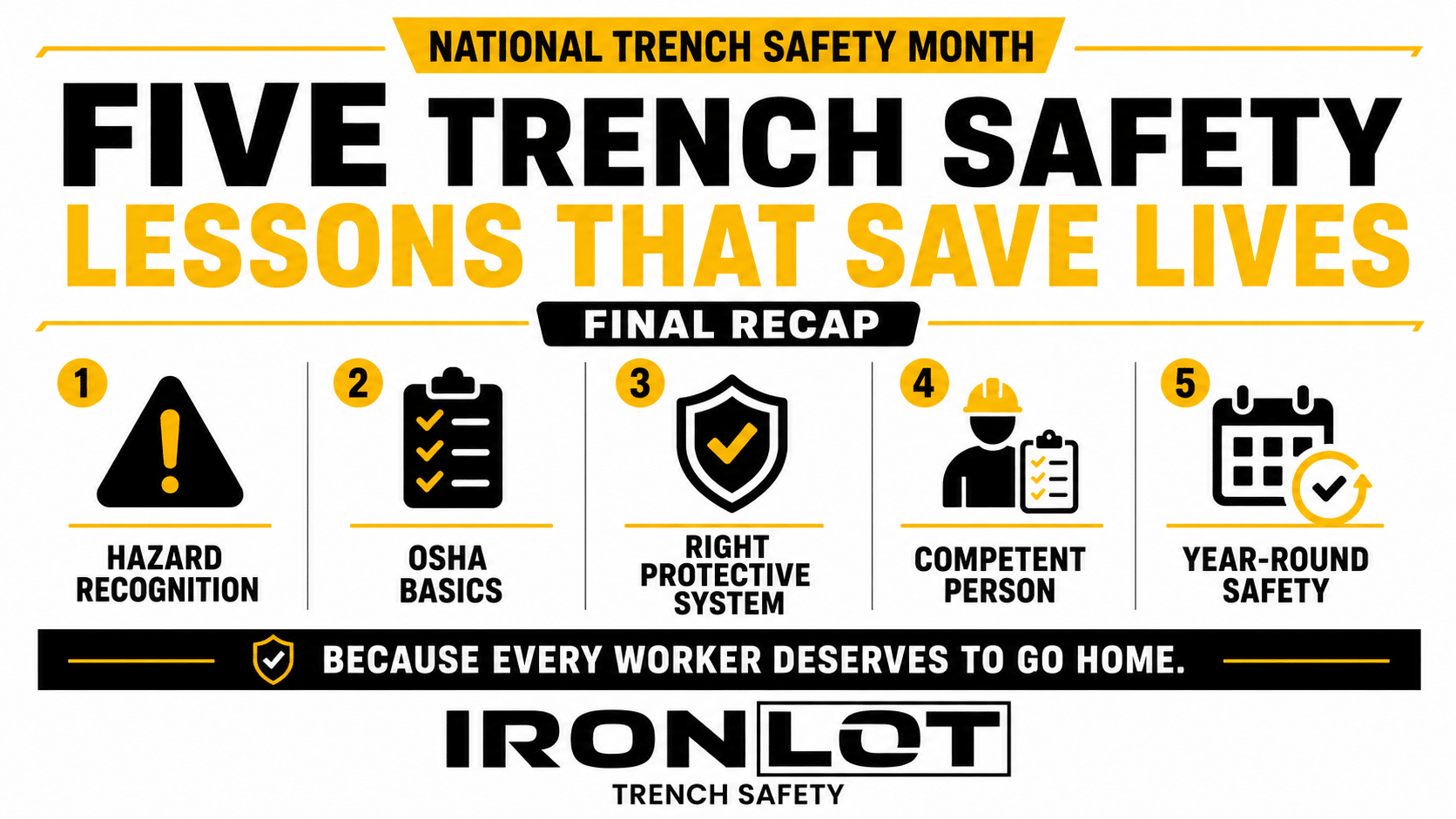
National Trench Safety Month — Final Recap
Five Trench Safety Lessons That Save Lives
Trench safety is not something crews should think about only during National Trench Safety Month.
It should be part of the way excavation work is planned, discussed, inspected, and performed every day.
Throughout Iron Lot’s National Trench Safety Month training series, we reviewed trench hazards, OSHA trench safety basics, protective systems such as trench boxes and shoring, and the role of the competent person.
Each topic matters on its own, but together they point to one larger message:
Trench safety saves lives when crews recognize hazards, use the right protective systems, and stop work when conditions become unsafe.
This final recap reviews five major trench safety lessons that should continue year-round.
Lesson 1: Trenches Can Become Dangerous Quickly
A trench may look stable, but conditions can change fast.
Soil can shift without warning. Water can collect in the excavation. Nearby traffic or equipment can create vibration. Spoil piles and materials near the edge can add pressure to the trench wall. Previously disturbed soil may behave differently than expected.
That is why hazard recognition is one of the most important parts of trench safety.
Common trench hazards include:
- Cave-ins
- Water accumulation
- Unstable or previously disturbed soil
- Spoil piles too close to the edge
- Heavy equipment near the excavation
- Falling material
- Poor access and egress
- Utility conflicts
- Workers outside the protected area
- Improper protective system use
Crews should never assume a trench is safe because it looked safe earlier in the day.
A safe trench requires ongoing attention.
Review Week 1: Understanding Trench Hazards
Lesson 2: OSHA Trench Safety Basics Must Be Understood
OSHA’s excavation standards are found in 29 CFR 1926 Subpart P.
These standards address important trench safety topics such as protective systems, inspections, access and egress, spoil pile placement, soil conditions, and competent person responsibilities.
OSHA generally requires workers in excavations to be protected from cave-ins by an adequate protective system, with limited exceptions such as excavations made entirely in stable rock or certain excavations less than 5 feet deep where a competent person finds no indication of a potential cave-in.
Crews should understand the basics before anyone enters the excavation.
Important OSHA trench safety basics include:
- Protective systems
- Soil classification
- Safe access and egress
- Spoil pile setback
- Daily inspections
- Competent person review
- Changing conditions
- Worker protection before entry
Knowing the rule is not enough.
The rule has to be applied on the jobsite.
Review Week 2: OSHA Trench Safety Basics
Lesson 3: The Right Protective System Matters
Protective systems are not one-size-fits-all.
A trench box, shoring system, sloping, or benching approach must be appropriate for the excavation, soil conditions, depth, water conditions, nearby loads, equipment access, and jobsite environment.
Trench boxes are shielding systems. They are designed to help protect workers inside the protected area if soil movement or a cave-in occurs.
Shoring systems are designed to support trench walls.
Both can be important, but they are not the same thing.
Protective system selection should consider:
- Trench depth
- Trench width
- Soil classification
- Water conditions
- Equipment near the excavation
- Adjacent structures
- Box size and configuration
- Spreader setup
- Manufacturer tabulated data
- Competent person review
A protective system should never be selected only because it is available, convenient, or already on the jobsite.
It must fit the excavation.
Review Week 3: Trench Boxes and Shoring
Lesson 4: The Competent Person Is Critical
The competent person is one of the most important roles on a trench site.
Under OSHA construction standards, a competent person must be capable of identifying existing and predictable hazards and must have authorization to take prompt corrective measures.
On an excavation site, that means the competent person must be able to recognize hazards and take action before workers are placed in danger.
Competent person responsibilities may include:
- Inspecting excavations
- Inspecting adjacent areas
- Inspecting protective systems
- Identifying signs of possible cave-ins
- Recognizing protective system failure
- Monitoring water accumulation
- Reviewing changing conditions
- Evaluating access and egress
- Reviewing soil and site conditions
- Taking corrective action when needed
OSHA requires competent person inspections of excavations, adjacent areas, and protective systems before work, as needed during the shift, and after rainstorms or other hazard-increasing events.
The competent person is not just a title.
It is a responsibility that requires knowledge, attention, and authority.
Review Week 4: The Competent Person
Lesson 5: Trench Safety Must Continue Year-Round
National Trench Safety Month is a good time to train, review, and refocus.
But trench safety cannot stop when the month ends. Ongoing trench safety training for all excavation workers is needed throughout the year.
The same principles should be used every time excavation work takes place:
- Plan the work before digging
- Identify hazards before entry
- Use the correct protective system
- Review manufacturer tabulated data
- Keep workers inside the protected area
- Provide safe access and egress
- Keep spoil piles and equipment back from the edge
- Inspect before entry
- Reinspect when conditions change
- Stop work when conditions become unsafe
Trench safety should be part of daily jobsite communication.
It should be discussed during planning, reinforced during toolbox talks, checked during inspections, and supported by the authority to take corrective action.
Year-Round Trench Safety Questions
Before workers enter an excavation, crews should be able to answer:
- Who is the competent person on this job?
- Has the excavation been inspected today?
- What hazards are present?
- What soil conditions are present?
- What protective system is being used?
- Has the manufacturer tabulated data been reviewed?
- Are workers staying inside the protected area?
- Is safe access and egress provided?
- Are spoil piles and equipment kept back from the edge?
- Have conditions changed since the last inspection?
- What would cause us to stop work?
If the crew cannot answer these questions, the trench should be reviewed before workers enter.
Use the Full Training Series
Iron Lot’s National Trench Safety Month training series was created to give contractors, utility crews, municipalities, and excavation companies practical resources they can share with their teams.
Review the full series:
- Week 1: Understanding Trench Hazards
- Week 2: OSHA Trench Safety Basics
- Week 3: Trench Boxes and Shoring
- Week 4: The Competent Person
These topics can be used for toolbox talks, crew meetings, safety reminders, and Trench Safety Stand Down discussions.
They are not a replacement for job-specific training, competent person review, OSHA requirements, manufacturer tabulated data, or professional engineering judgment when required.
They are a practical starting point for keeping Trench Safety Training in front of the crew.
Final Takeaway
Trench safety depends on daily decisions.
The decision to inspect.
The decision to use the right protective system.
The decision to review tabulated data.
The decision to remove workers when conditions change.
The decision to stop work when something does not look right.
Those decisions can save lives.
Because every worker deserves to go home.
Need Trench Safety Equipment?
Iron Lot supplies trench safety equipment for contractors, municipalities, and utility crews, including steel trench boxes, aluminum trench boxes, modular aluminum panel systems, road plates, bedding boxes, and related equipment.
If you need help comparing trench box options or reviewing available equipment for your next project, contact Iron Lot for current availability, specifications, and quote support.