
Trench Safety Stand Down Week 2026: A Good Time to Stop, Talk, and Train
Trench Safety Stand Down Week 2026 is scheduled for June 15–19, 2026. For contractors, utility crews, municipalities, and excavation companies, this week is a reminder to pause normal production long enough to talk directly with crews about trench safety.
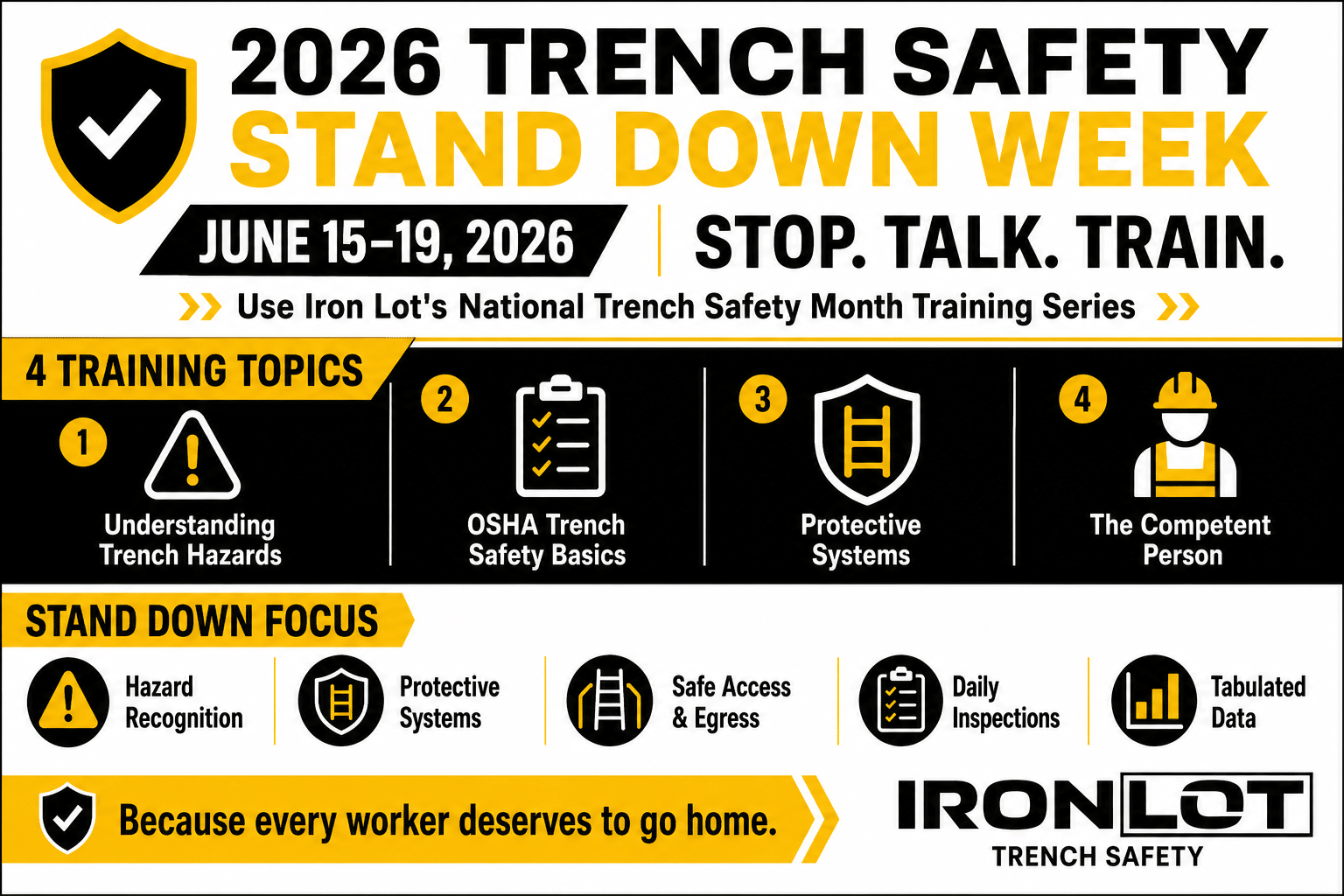
A stand down does not need to be complicated. It can be a short toolbox talk, a crew meeting, a review of trench safety basics, or a jobsite discussion before work begins. The goal is simple:
Help workers recognize trench hazards before someone gets hurt.
Trenching and excavation work can become dangerous quickly. Soil movement, water accumulation, spoil piles, equipment near the edge, utility conflicts, and improper protective system use can all create serious hazards.
That is why Iron Lot is using National Trench Safety Month to provide free weekly training resources that contractors can share with their crews.
You can view the full Iron Lot training series here: National Trench Safety Month Training Series.
What Is Trench Safety Stand Down Week?
Trench Safety Stand Down Week is an industry-wide opportunity for employers to talk with workers about excavation hazards, protective systems, OSHA requirements, and safe jobsite practices.
NUCA lists Trench Safety Stand Down Week 2026 as June 15–19, 2026. OSHA’s trenching and excavation resources also list the 2026 Trench Safety Stand Down for June 15–19.
Learn more from NUCA Trench Safety Stand Down and OSHA trenching and excavation resources.
A stand down can be held in the yard, at the office, or directly on the jobsite. It does not have to be long, but it should be practical.
Good stand down topics include:
- Trench hazard recognition
- Cave-in prevention
- Protective systems
- Soil classification
- Safe access and egress
- Spoil pile placement
- Daily inspections
- Competent person responsibilities
- Manufacturer tabulated data
- Common jobsite mistakes
The best stand downs are not just lectures. They give crews a chance to ask questions, review real jobsite conditions, and talk about what can go wrong when trench safety basics are ignored.
Why Trench Safety Stand Down Week Matters
Trench safety is not only a compliance issue. It is a life safety issue.
A trench can look stable one minute and fail the next. Workers in and around excavations need to understand that conditions can change quickly due to rain, vibration, traffic, nearby equipment, water, previously disturbed soil, or added surcharge loads.
Protective systems must be selected, installed, inspected, and used correctly.
That starts with training, planning, and the involvement of a competent person.
Use Iron Lot’s Trench Safety Month Training Series
To support National Trench Safety Month and Trench Safety Stand Down Week, Iron Lot is publishing a free weekly training series contractors can use with their crews.
These resources are designed to be practical, easy to share, and useful for jobsite safety conversations.
Week 1: Understanding Trench Hazards
Week 1 focuses on common trench hazards, including cave-ins, water accumulation, utility dangers, access and egress issues, and the role of the competent person.
This training is a good starting point for any stand down because it helps workers understand why trench safety must be taken seriously before anyone enters an excavation.
Read Week 1: Understanding Trench Hazards
Week 2: OSHA Trench Safety Basics
Week 2 reviews core OSHA trench safety concepts, including protective system requirements, soil classification, spoil pile setback, access and egress, inspections, and competent person responsibilities.
This is a strong training topic for crews that need a refresher on the basics of trench safety compliance.
Read Week 2: OSHA Trench Safety Basics
Week 3: Trench Boxes and Shoring
Week 3 focuses on choosing the right protection system for the job.
This training covers trench boxes, shoring, steel vs. aluminum trench boxes, soil and depth ratings, manufacturer tabulated data, common mistakes, and competent person review.
A trench box or shoring system should never be selected by convenience alone. The system must be appropriate for the excavation, soil conditions, depth, configuration, and jobsite environment.
Read Week 3: Trench Boxes and Shoring
Week 4: The Competent Person
Week 4 focuses on one of the most important roles on a trench site: the competent person.
The competent person must be able to identify hazards, evaluate soil and site conditions, inspect excavations, review protective systems, and take corrective action when unsafe conditions exist.
(Availble June, 22nd)Read Week 4: The Competent Person
Suggested Topics for Your 2026 Trench Safety Stand Down
If you are planning a stand down for your crew, consider building the discussion around practical questions that connect directly to real jobsite decisions.
- What trench hazards are most common on our jobs?
- What conditions can change during the day?
- Who is the competent person on this job?
- What protective system is being used?
- Has the manufacturer tabulated data been reviewed?
- Are workers staying inside the protected area?
- Are spoil piles and equipment kept back from the trench edge?
- Is safe access and egress provided?
- Has the excavation been inspected today?
- What would cause us to stop work?
These questions can help crews connect training topics to real jobsite decisions.
Printable Training Documents
Iron Lot’s training series also includes printable documents that can be used for short crew meetings, toolbox talks, or documented training.
Each printable training document includes:
- Training objectives
- Key discussion points
- Safety reminders
- Discussion questions
- Knowledge check
- Employee acknowledgement
- Instructor verification
- Attendance record
These documents are designed to help contractors keep the training simple, organized, and easy to repeat with multiple crews.
View all Iron Lot trench safety training resources for Trench Safety Month
Trench Safety Requires the Right Equipment and the Right Review
Training is important, but equipment selection also matters.
Iron Lot supplies trench safety equipment for contractors, utility crews, municipalities, and excavation companies, including:
- Trench boxes
- Steel trench boxes
- Aluminum trench boxes
- Bedding boxes
- Road plates
- Road plate lifters
- Trench safety products
Every trench box Iron Lot sells comes with manufacturer tabulated data that includes depth ratings and a registered professional engineer stamp.
That does not mean every trench box is right for every job. The competent person must still review the excavation, soil conditions, depth, configuration, spreader setup, tabulated data, and jobsite conditions before workers enter the trench.
For more help comparing equipment options, review Iron Lot’s guide on how to choose a trench box.
Make Trench Safety Stand Down Week Count
Trench Safety Stand Down Week is a good time to stop and ask whether your crews are prepared.
- Do workers understand the hazards?
- Has the protective system been selected properly?
- Is the competent person reviewing conditions before entry?
- Are workers staying inside the protected area?
- Are the basics being followed every day?
A short conversation can make a difference when it leads to better planning, better inspections, and safer decisions on the jobsite.
Because every worker deserves to go home.
Need Trench Safety Equipment?
If your crew needs trench boxes, aluminum trench boxes, steel trench boxes, road plates, bedding boxes, or related trench safety equipment, contact Iron Lot.
We can help you compare available equipment options, review specifications, and request current pricing.