
Hydraulic Shoring Sheeting Requirements
Sheeting can be an important part of a vertical hydraulic shoring system when soil is likely to slough or ravel between adjacent shore locations.
Whether sheeting is required, which materials can be used, and how far the sheeting must extend depend on the excavation conditions and the manufacturer's current tabulated data.
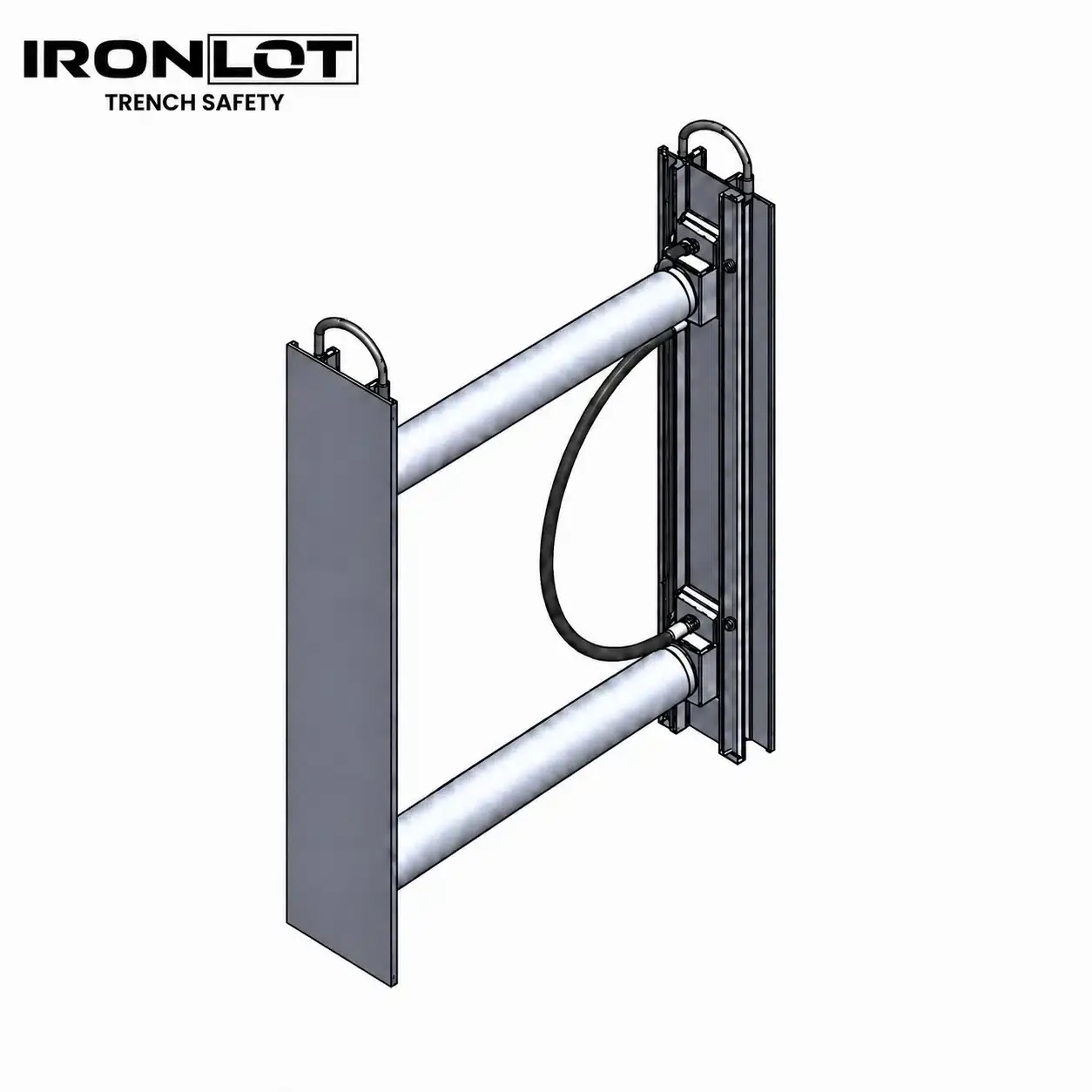
What Is Sheeting in Hydraulic Shoring?
Vertical hydraulic shores provide support at individual rail locations, leaving portions of the excavation wall exposed between adjacent shores.
Sheeting is material placed against the excavation wall to help retain soil that may slough or ravel between those support locations.
Depending on the system, sheeting may be attached to the hydraulic shore or installed separately behind the rails.
Sheeting is used to help control sloughing and raveling between hydraulic shores. It should not be treated as a substitute for the hydraulic-shoring system itself.
What Does Sheeting Do?
Retains Loose Soil
Sheeting can retain material that would otherwise slough, ravel, or fall from the exposed trench wall between adjacent hydraulic shores.
Not the Primary Structural Element
In the current tabulated data supplied with the vertical shores sold by Iron Lot, sheeting is used for soil retention and is not treated as the primary structural support element of the system.
When Is Sheeting Required?
The need for sheeting is determined by the actual excavation conditions and the applicable manufacturer's tabulated data.
The current tabulated data supplied with these vertical hydraulic shores requires sheeting whenever sloughing or raveling is likely to occur.
Sloughing
Soil breaking loose and moving away from the excavation wall can indicate that additional wall retention is needed.
Raveling
Small pieces of soil continually falling or shedding from the trench wall can require sheeting between shore locations.
Depth and Soil Conditions
Certain combinations of excavation depth and soil classification may carry specific sheeting requirements in the applicable tabulated data.
Changing Conditions
Water, vibration, soil movement, or other changing jobsite conditions can create a need for sheeting even if it was not initially required.
What Materials Can Be Used for Sheeting?
Sheeting material should not be selected simply because it is available on the jobsite.
The material must be permitted by the applicable manufacturer's current tabulated data and meet the required material, thickness, and strength requirements.
The current tabulated data supplied with the vertical shores sold by Iron Lot includes several allowable sheeting options.
The tabulated data lists several specified plywood configurations and exterior-grade panel products.
Manufacturer-approved aluminum sheeting may be used where permitted by the applicable system requirements.
Specified timber lagging sizes and grades are included among the allowable materials in the current tabulated data.
The current supplied tabulated data includes steel plate meeting the specified minimum thickness.
Equivalent supported timber materials may be acceptable when they meet the requirements of the applicable tabulated data.
Supported HDPE products with the required equivalent properties may be permitted under the applicable manufacturer requirements.
A sheet of plywood, timber, plastic, or steel is not automatically acceptable simply because it fits behind the shore. Use materials permitted by the current tabulated data.
How Is Sheeting Positioned?
Sheeting placement depends on the specific tabulated configuration being used.
The current manufacturer data supplied with these shores includes several important placement requirements.
When sheeting is required under the supplied tabulated data, it must extend to the top of the excavation.
Some tabulated configurations require a specific width of sheeting behind each hydraulic shore.
Depending on the applicable configuration, sheeting may be required to extend to within a specified distance of the excavation bottom.
Other tabulated configurations require the sheeting to extend all the way to the bottom of the excavation.
Attached vs. Separate Sheeting
Allowable sheeting may be incorporated into the hydraulic shore assembly or placed separately against the trench wall, depending on the equipment and the applicable system configuration.
The installation method should maintain the required shore spacing, wall contact, cylinder placement, and sheeting coverage established by the current tabulated data.
Can Sheeting Affect Shore Spacing?
Yes. Sheeting and shore spacing are part of the same protective-system layout.
The supplied manufacturer data states that if sloughing or raveling continues between the sheeting, the spacing should be decreased until the condition is controlled.
This is another reason hydraulic-shore spacing should not be selected independently from soil conditions and sheeting requirements.
Watch for Changing Excavation Conditions
Sheeting requirements can change during the project. Conditions that were stable when the shores were first installed may change as excavation work continues.
The Competent Person should continue monitoring the excavation and reevaluate the protective system when conditions change.
Common Sheeting Mistakes to Avoid
A few recurring mistakes can place a hydraulic-shoring layout outside the intended tabulated configuration.
- Assuming sheeting is unnecessary because shores are already installed.
- Using material that is not permitted by the applicable tabulated data.
- Stopping sheeting short of the required top or bottom coverage.
- Ignoring sloughing or raveling that develops after installation.
- Treating sheeting as independent from hydraulic-shore spacing.
- Failing to reevaluate the system when soil or water conditions change.
Sheeting Is Part of the Complete System
Do not determine sheeting requirements from trench depth or soil classification alone. Sloughing, raveling, excavation depth, shore spacing, surcharge loads, groundwater, allowable materials, required sheeting depth, manufacturer tabulated data, and Competent Person review all affect the complete hydraulic-shoring system.
Need Hydraulic Shoring for an Upcoming Project?
Iron Lot supplies vertical hydraulic shores and related hydraulic-shoring equipment for underground utility, municipal, public works, and excavation projects. Contact us for current pricing, availability, and freight coordination.