
What Is Hydraulic Shoring?
Hydraulic shoring is a trench-support system that uses hydraulic cylinders and vertical rails to apply controlled pressure against opposing excavation walls.
It is commonly used by utility contractors, municipalities, public works departments, and underground construction crews to provide trench-wall support while maintaining an open working area inside the excavation.
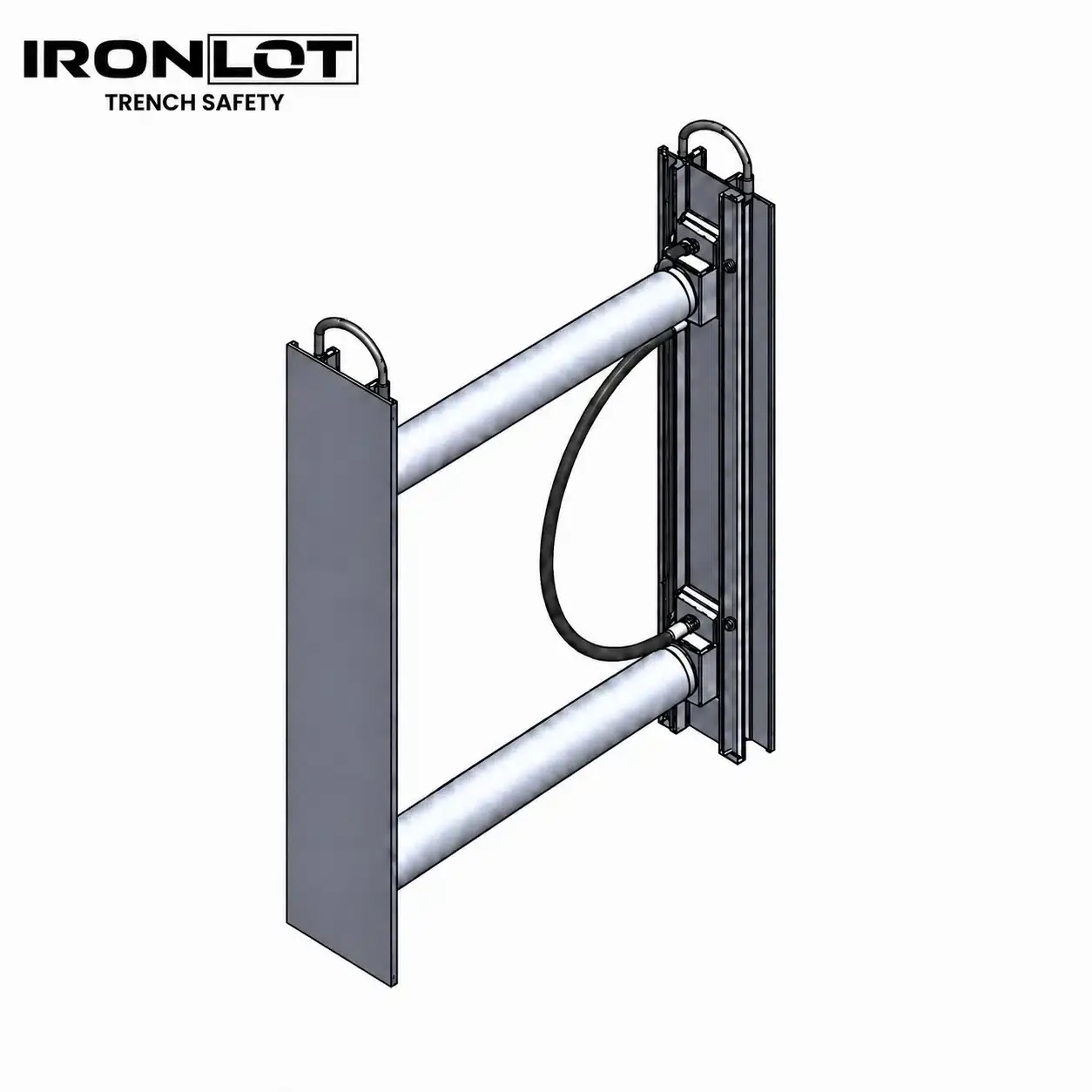
How Does Hydraulic Shoring Work?
A typical vertical hydraulic shore consists of two aluminum rails connected by one or more hydraulic cylinders.
The shore is positioned between opposing excavation walls. Hydraulic pressure extends the cylinders, pushing the rails firmly against the soil.
Multiple shores are installed along the excavation at the spacing required by the manufacturer's current tabulated data. Together, the individual shores form a complete trench-support system.
Hydraulic shoring supports the trench walls. A trench box primarily shields workers from surrounding soil.
Why Use Hydraulic Shoring?
One of the primary advantages of vertical hydraulic shoring is the amount of access it can provide inside the excavation.
Open Trench Access
Provides access to pipe, fittings, valves, utility connections, existing utilities, and excavation walls without continuous shield panels.
Efficient Excavation Width
Hydraulic shores can reduce the space occupied by protective equipment where the complete system and working-clearance requirements permit.
Flexible Configurations
Different rail lengths and cylinder ranges allow hydraulic-shoring equipment to be configured for different excavation conditions.
How Is Hydraulic Shoring Installed?
Vertical hydraulic shores are designed so the protective system can be established from outside the excavation before workers enter the protected area.
Classify the soil and evaluate the excavation, surcharge loads, groundwater, and other jobsite conditions.
Determine the required shore configuration and spacing from the manufacturer's current tabulated data.
Lower the folded hydraulic shore into the excavation from outside the trench and open it against the walls.
Apply the manufacturer-specified hydraulic pressure and establish firm contact with opposing trench walls.
Install all additional shores and required sheeting at the applicable horizontal and vertical spacing.
The Competent Person should inspect the completed protective system before workers enter the excavation.
Does Soil Type Matter?
Yes. Soil classification is an important part of selecting and laying out a hydraulic-shoring system.
Soil conditions affect allowable excavation depth, horizontal shore spacing, vertical cylinder placement, sheeting requirements, and the overall protective-system configuration.
The project Competent Person must classify the soil and use the applicable manufacturer tabulated data. Soil conditions should also be reevaluated when rainfall, groundwater, vibration, excavation activity, nearby equipment, or other jobsite conditions change.
Does Hydraulic Shoring Require Sheeting?
Not every hydraulic-shoring installation requires the same sheeting configuration.
Vertical hydraulic shores leave portions of the trench wall exposed between adjacent rails. Where soil is likely to slough or ravel, allowable sheeting may be required to retain loose material.
The material, thickness, dimensions, and installation depth of any sheeting must comply with the applicable manufacturer's current tabulated data.
Hydraulic Shoring vs. a Trench Box
Hydraulic shoring and trench boxes are both used to protect workers in excavations, but they perform different functions.
Hydraulic shoring applies support directly to opposing trench walls. A trench box creates a protected working area inside the shield.
Hydraulic shoring can be particularly useful when crews need direct access to the excavation walls or when minimizing unnecessary excavation width is important. Trench boxes are often practical for repetitive mainline pipe installation and projects where a larger shielded working area can move with production.
Read the complete Hydraulic Shoring vs. Trench Boxes Guide →
Common Hydraulic Shoring Applications
Vertical hydraulic shores are commonly used for localized and linear underground utility excavation.
Actual suitability depends on the excavation dimensions, soil conditions, utility components, working clearance, surcharge conditions, and the complete protective-system design.
Hydraulic Shoring Is a Complete System
A hydraulic shore should not be selected solely because its cylinder range fits the trench or its rail length appears to match the excavation depth. Soil classification, excavation depth, shore spacing, cylinder placement, surcharge loads, groundwater, sheeting requirements, manufacturer tabulated data, and Competent Person review all affect the protective-system layout.
Need Hydraulic Shoring Equipment?
Iron Lot supplies vertical hydraulic shores, pumps, hoses, installation tools, sheeting, replacement components, and related trench-safety equipment for underground utility, municipal, and public works projects.