
What Size Road Plate Do I Need for a 4-Foot-Wide Trench?
A 4-foot-wide trench may calculate to a 6-foot minimum road plate width, but that leaves very little margin for imperfect placement or movement. For real-world field conditions, Iron Lot generally recommends an 8-foot-wide road plate.
Practical recommendation: For a typical 4-foot-wide trench, start with an 8-foot-wide road plate, then confirm plate thickness, unsupported span, loading, supporting surfaces, placement, and securing requirements.
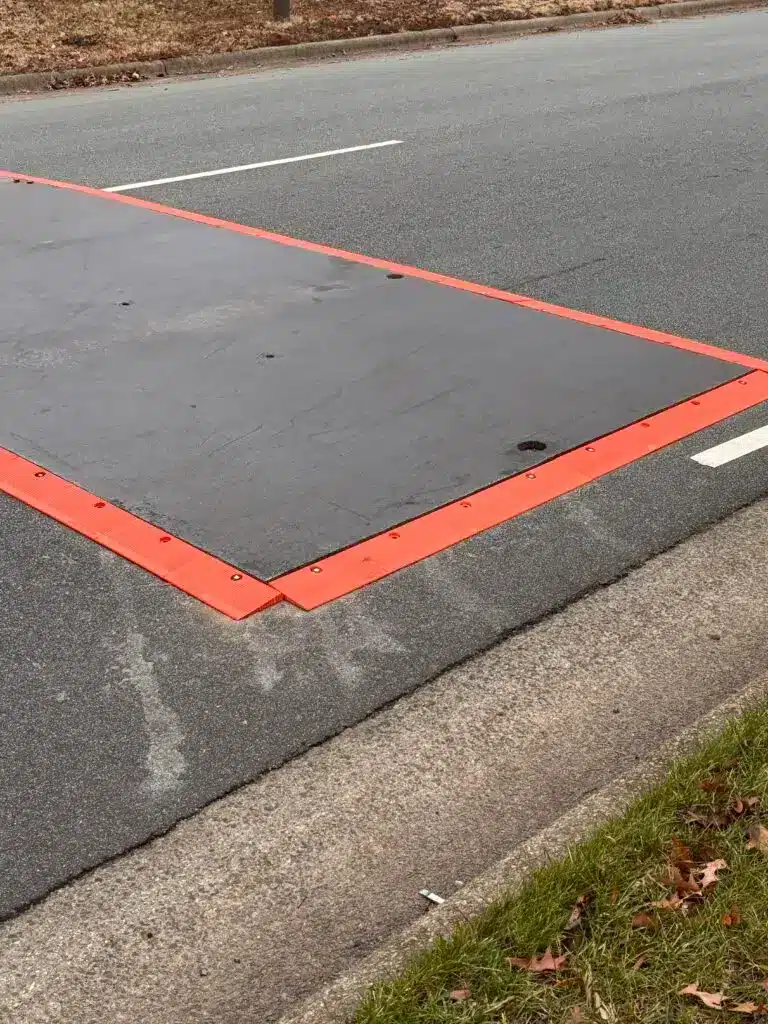
How the Minimum Plate Width Is Calculated
Iron Lot's road plate tabulated data requires a minimum of 12 inches of bearing on each side of the opening.
For a 4-foot-wide trench, the basic calculation is:
Why Iron Lot Recommends an 8-Foot Plate
A 6-foot-wide plate provides the required 12 inches of bearing on each side only when the trench is exactly 4 feet wide and the plate is positioned correctly.
That leaves very little margin for normal field conditions.
Trench Width Can Vary
Excavations are not always perfectly straight or exactly the planned width at every point.
Placement Can Be Off-Center
Even a small positioning difference can reduce the available bearing on one side of the trench.
Plates Can Move
Traffic, equipment, vibration, and jobsite activity can contribute to movement if the plate is not properly secured.
For a 4-Foot Trench, an 8-Foot-Wide Plate Provides More Margin
An 8-foot-wide plate centered over a 4-foot opening provides approximately 2 feet of bearing on each side. That gives significantly more tolerance than beginning with the minimum 12 inches.
The wider plate does not replace proper placement or securing. The required bearing must still be maintained.
6-Foot Plate vs. 8-Foot Plate
A 6-foot plate centered over a 4-foot opening provides approximately 12 inches of bearing per side.
This satisfies the basic width calculation but leaves essentially no additional margin for imperfect placement.
An 8-foot plate centered over a 4-foot opening provides approximately 24 inches of bearing per side.
The additional width gives the installer more tolerance for actual field dimensions, positioning, and potential movement.
Road Plate Thickness Matters Too
Selecting a plate that is wide enough does not automatically mean it is thick enough for the opening being crossed. Plate thickness affects the maximum allowable unsupported span under Iron Lot's road plate tabulated data.
| Steel Plate Thickness | Maximum Unsupported Span |
|---|---|
| 1 in. | 4 ft. 6 in. |
| 1 1/4 in. | 7 ft. |
Width and Thickness Answer Different Questions
Plate width determines whether there is enough plate extending beyond the opening to provide the required bearing.
Plate thickness determines whether the plate is suitable for the unsupported span it must bridge.
Plate Width Is Not the Same as Unsupported Span
If an 8-foot-wide plate is placed over a 4-foot-wide trench, the plate is not spanning 8 feet.
The unsupported span is the portion of the plate crossing the opening. The plate extending beyond the opening provides bearing on the supporting surfaces.
For a 4-foot opening, the unsupported portion is approximately 4 feet, assuming the supporting surfaces begin at the trench edges.
Other Factors Affect Road Plate Selection
Trench width, bearing, and plate thickness are major considerations, but they are not the only factors that determine the appropriate road plate for an application.
Traffic & Loading
Consider the vehicles, construction equipment, and other loads that will cross or act on the plate.
Supporting Surface
The area beneath the road plate must provide suitable bearing and support for the application.
Actual Opening Size
Measure the excavation in the field instead of relying only on the planned or nominal trench width.
Placement & Securing
The plate must be positioned and secured so the required bearing is maintained under the expected jobsite conditions.
Minimum Size vs. Practical Field Recommendation
Based on a 4-foot opening plus 12 inches of required bearing on each side.
Provides additional bearing area and more tolerance for real-world field placement and movement.
Measure the Actual Opening
A trench described as 4 feet wide may not measure exactly 48 inches everywhere. Excavation geometry, trench conditions, and normal field tolerances can cause the opening to vary.
Before selecting a plate, confirm the actual opening dimensions and consider where the plate will bear on both sides.
Have These Details Ready
- Actual trench or opening width
- Traffic or equipment crossing the plate
- Supporting surface conditions
- Available plate dimensions
- How the plate will be positioned and secured
Review the Road Plate Tabulated Data
Iron Lot provides road plate sizing information and tabulated data so contractors can review bearing requirements, unsupported spans, plate thicknesses, and other applicable requirements before ordering.
Tell Us Your Trench Width and Application
If you know the width of your trench or opening, the traffic or equipment that will cross it, and the conditions where the plate will be installed, Iron Lot can help you review the available road plate options.
For a 4-foot-wide trench, our practical starting recommendation is typically an 8-foot-wide plate, but the final selection must also account for plate thickness, unsupported span, loading, supporting surfaces, placement, and securing.
Contact Iron LotImportant: Road plate selection and installation must follow the applicable tabulated data and project requirements. Site conditions can vary, and the appropriate plate size and configuration should be determined for the specific application.