Description
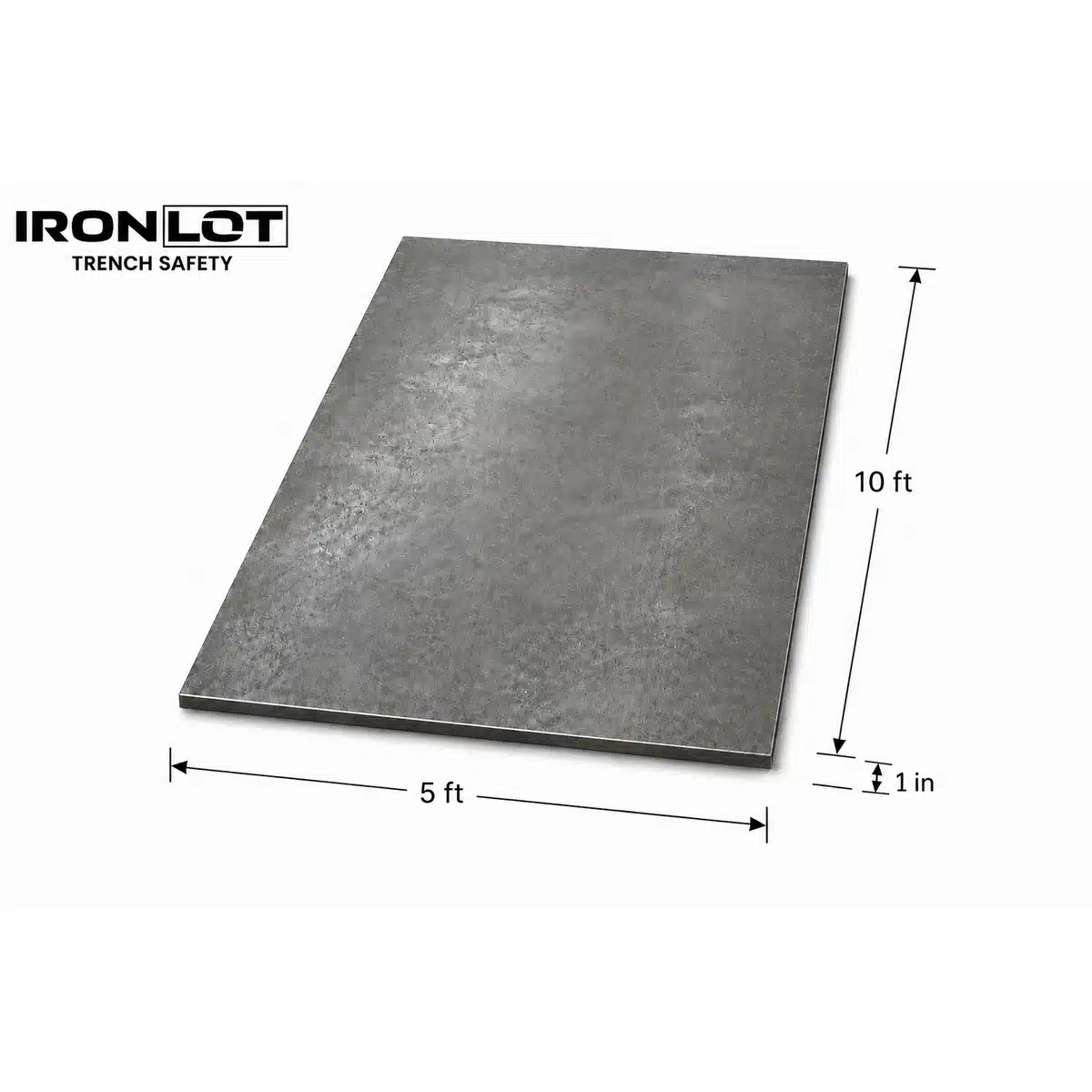
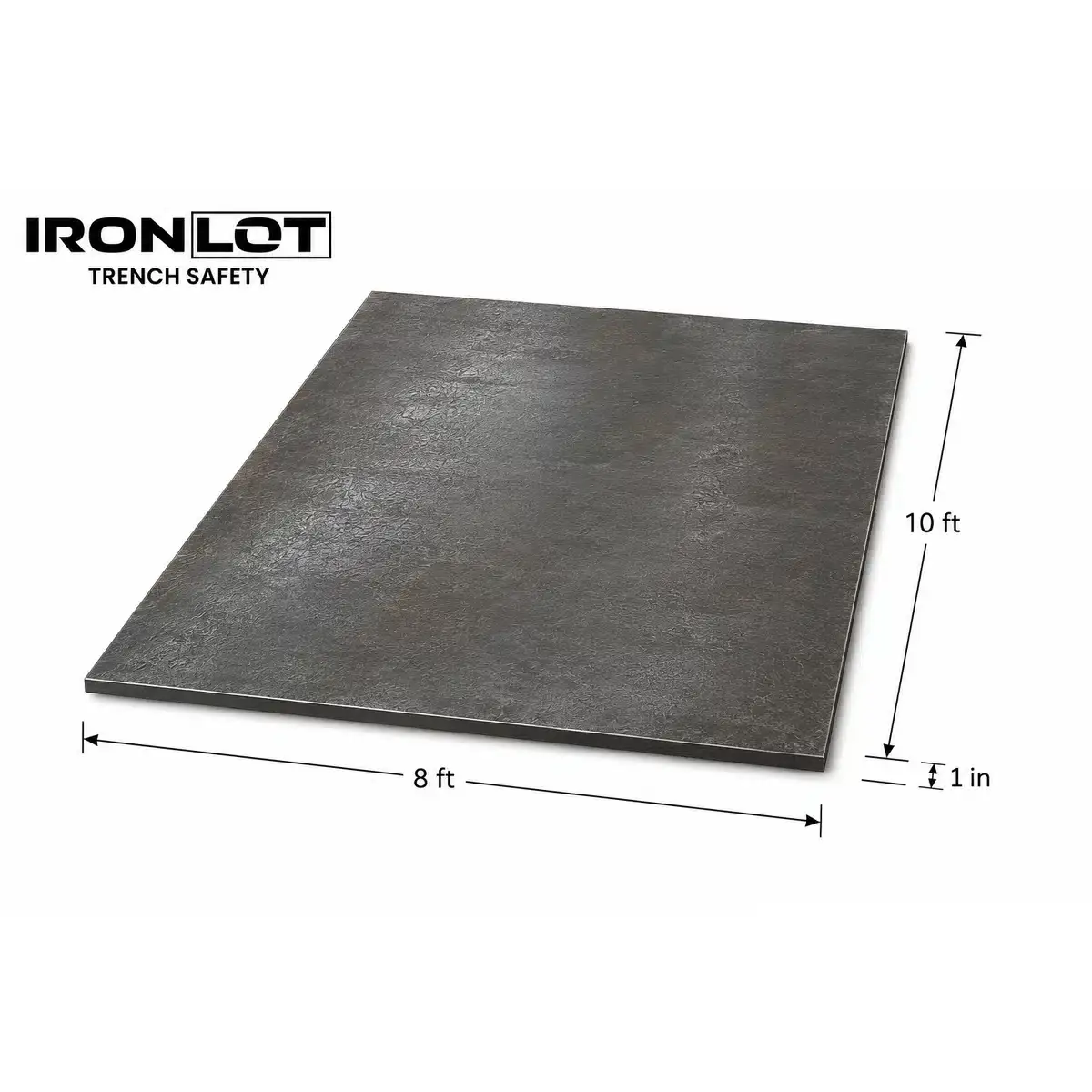
8′ x 10′ Steel Road Plate
The Iron Lot 8′ x 10′ Steel Road Plate provides temporary coverage for utility trenches, pavement cuts, access openings, and excavations in streets, parking areas, driveways, and construction sites.
Its 8-foot width provides substantial cross-trench coverage, while the 10-foot length extends along the excavation to support compatible utility, roadway, and infrastructure work. This configuration offers more longitudinal coverage than an 8′ x 8′ plate while remaining smaller and lighter than longer road-plate options.
The 8′ x 10′ road plate is available in 1-inch and 1¼-inch thicknesses. Iron Lot’s applicable tabulated data is based on HS20-44 traffic loading and minimum ASTM A36 steel with a 36 ksi yield strength.
Road-plate selection must account for more than exterior dimensions. The clear opening, direction of span, required edge overlap, plate thickness, supporting surfaces, traffic conditions, anchorage, and transition-ramp requirements must all be evaluated before installation.
Key Benefits & Crew Efficiency
-
Versatile 8′ x 10′ Configuration: Provides substantial temporary coverage for compatible utility trenches, pavement openings, and excavation work.
-
Extended 10-Foot Length: Offers additional longitudinal coverage compared with an 8′ x 8′ road plate.
-
Two Thickness Options: Available in 1-inch and 1¼-inch steel for different span, weight, and handling requirements.
-
HS20-44 Design Basis: Covered by Iron Lot tabulated data for HS20-44 traffic loading when all specified installation conditions are satisfied.
-
ASTM A36 Steel: Manufactured from minimum ASTM A36 steel with a specified yield strength of 36 ksi.
-
Published Plate Weights: Weighs approximately 3,267 lbs at 1 inch thick or 4,084 lbs at 1¼ inches thick.
-
Reusable Temporary Coverage: Suitable for contractors, municipalities, public works departments, and utility crews that regularly cover roadway and excavation openings.
-
Substantial Bearing Area: The plate dimensions provide room for the required edge overlap when used over compatible openings.
Product Specifications
| Product | Steel Road Plate |
|---|---|
| Dimensions | 8′ Wide x 10′ Long |
| Material | Minimum ASTM A36 Steel |
| Minimum Yield Strength | 36 ksi |
| Available Thicknesses | 1 Inch or 1¼ Inches |
| Weight – 1 Inch | Approx. 3,267 lbs |
| Weight – 1¼ Inches | Approx. 4,084 lbs |
| Maximum Allowed Span – 1 Inch | 4′6″ |
| Maximum Allowed Span – 1¼ Inches | 7′0″ |
| Traffic-Loading Design Basis | HS20-44 |
Pricing & Logistics
Contact Iron Lot for Current Pricing and Availability
Contact us to confirm current pricing, available thicknesses, quantities, freight rates, and estimated delivery timing.
Freight & Delivery Coordination
Shipping requirements depend on plate thickness, quantity, total order weight, delivery location, and unloading arrangements.
Approximate plate weights are:
-
1-inch plate: 3,267 lbs;
-
1¼-inch plate: 4,084 lbs.
The trailer, lifting equipment, rigging, and unloading method must be rated for the selected plate and the planned handling procedure.
The 8-foot width, 10-foot length, and substantial plate weight require sufficient space for loading, unloading, placement, removal, and storage.
We can coordinate delivery to your contractor yard, municipal facility, equipment location, or jobsite and provide quotes for multiple road plates or mixed-equipment orders.
Target Applications
The 8′ x 10′ steel road plate is intended for temporary coverage of compatible openings where the required bearing area, edge overlap, support conditions, and traffic requirements can be maintained.
Potential applications include:
-
water and sewer utility cuts;
-
gas, electrical, and telecommunications trenches;
-
utility tie-in and service-connection excavations;
-
valve, meter-vault, and utility-access openings;
-
localized pavement repairs;
-
roadway and infrastructure projects;
-
municipal and public works repairs;
-
parking-lot and driveway openings;
-
temporary roadway coverage;
-
contractor-yard and construction-site openings;
-
utility repair and replacement work.
The 10-foot length provides additional coverage along the excavation, while the 8-foot dimension may be positioned across a compatible opening when the required overlap and structural span limits can be maintained.
Actual suitability depends on the opening dimensions, plate orientation, selected thickness, supporting surfaces, traffic conditions, and installation requirements. The road plate should not be selected solely because the opening appears smaller than its exterior dimensions.
Critical Selection & Installation Factors
Is an 8×10 Road Plate Right for Your Opening?
Road-plate selection requires more than comparing the plate size with the excavation dimensions.
The correct plate depends on:
-
clear trench or opening dimensions;
-
direction in which the plate will span;
-
required edge overlap;
-
plate thickness;
-
traffic type and speed;
-
supporting-surface condition;
-
pavement or soil stability;
-
vehicle loading;
-
slope;
-
anchorage requirements;
-
transition-ramp requirements;
-
available lifting and placement equipment.
The tabulated maximum span is a structural limit. It does not automatically establish the allowable trench width for every installation.
Adequate overlap must remain beyond the excavation on all required supporting sides. The plate must also maintain positive contact with the supporting surfaces.
When the 8-foot dimension is positioned across an asphalt trench carrying traffic under 45 mph, the edge-overlap requirement permits an opening of up to approximately 6 feet. The structural span limit may reduce that opening depending on plate thickness:
-
1-inch plate: maximum structural span of 4′6″;
-
1¼-inch plate: maximum structural span of 7 feet, with the 12-inch-per-side overlap requirement limiting an 8-foot plate dimension to an opening of approximately 6 feet.
For asphalt traffic over 45 mph or dirt traffic under 45 mph, the required 24 inches of overlap per side limits an opening beneath the 8-foot plate dimension to approximately 4 feet.
These examples assume stable supporting conditions and compliance with all other tabulated requirements. A larger plate or engineered installation is required when the opening exceeds the applicable span or overlap limit.
HS20-44 Loading & Maximum Span
The Iron Lot tabulated data is based on HS20-44 traffic loading.
The published maximum allowed spans are:
-
1-inch steel plate: 4′6″;
-
1¼-inch steel plate: 7′0″.
These span limits do not override minimum edge-overlap requirements. The allowable opening is controlled by whichever requirement produces the smaller permitted span.
The plate may be oriented differently for a particular excavation, but neither the 8-foot nor the 10-foot exterior dimension increases the published structural span limit.
Any opening, loading condition, plate arrangement, or installation exceeding the tabulated limits requires engineering.
The chart is based on a stable trench. Stability must be determined by the project’s Competent Person or engineer.
Edge Overlap & Traffic Conditions
The tabulated data provides the following minimum plate-sizing relationships:
-
Asphalt traffic under 45 mph: trench width plus 24 inches minimum, providing 12 inches of overlap per side;
-
Asphalt traffic over 45 mph: trench width plus 48 inches minimum, providing 24 inches of overlap per side;
-
Dirt traffic under 45 mph: trench width plus 48 inches minimum, providing 24 inches of overlap per side.
Plates used on dirt where traffic speeds exceed 45 mph require engineering.
Plates used on asphalt or concrete where traffic speeds exceed 55 mph also require engineering.
The required overlap must be evaluated in both directions where necessary so the plate remains fully supported around the excavation.
Placement, Support & Anchorage
Road plates must be placed with positive contact on all supporting surfaces. Voids beneath the plate can permit movement, rocking, impact loading, or excessive deflection.
Cold patch may be used to displace voids between the plate and supporting surface where appropriate.
The tabulated data states that anchorage may be required when:
-
traffic speeds exceed 45 mph;
-
the installation is on a slope greater than 5%;
-
local requirements call for anchorage;
-
the Competent Person or engineer determines that movement must be restrained.
Anchorage, recessing, welds, bolts, pins, and other installation details must be appropriate for the actual roadway and project conditions.
Transition Ramps
The tabulated installation detail calls for a minimum 18-inch cold-mix transition ramp around the road plate.
The transition helps reduce abrupt tire impact at the plate edge and provides a smoother path for traffic crossing the installation.
Ramp construction, plate recessing, signage, traffic control, inspection frequency, and maintenance requirements may vary by jurisdiction, project owner, and roadway authority.
The contractor must confirm all applicable state, local, owner, and project-specific requirements before placing the road plate into service.
Inspection & Handling
Road plates should be inspected before installation and periodically while in service.
Inspect for:
-
permanent bending or deformation;
-
cracks or damaged edges;
-
excessive corrosion or material loss;
-
damaged lifting points;
-
worn or damaged surfaces;
-
failed welds or attachments;
-
plate movement or loss of bearing;
-
deteriorated transition ramps;
-
voids beneath the plate;
-
loose or damaged anchorage.
Damaged or questionable plates should be removed from service until they have been evaluated.
Road plates should only be lifted and positioned using properly rated machinery, rigging, and lifting points. Workers must remain clear of suspended plates and pinch points during loading, unloading, placement, and removal.
Request a Quote from Iron Lot
We supply steel road plates, trench plates, trench boxes, manhole boxes, bedding boxes, and other equipment for underground utility and excavation contractors.
Contact our team for:
-
current pricing and availability;
-
1-inch and 1¼-inch plate options;
-
additional road-plate sizes;
-
multiple-plate quotes;
-
available fabrication options;
-
freight and delivery coordination;
-
trench-safety equipment;
- equipment financing information.
Get a Quote
Warehouse Shipping Locations: Multiple Locations
Payment Options:
We accept company check, wire transfer, ACH, and credit card payments. We also offer financing through Ascentium Capital.
Financing: Ascentium Capital offers fast and flexible financing. With their quick and convenient way to purchase equipment, working with Ascentium Capital helps you acquire the funds you need for your equipment purchase. With financing and leasing of up to $2,000,000, Ascentium Capital works with you to make the application process simple and at no obligation.
To learn more about Ascentium Capital and how it can assist you, click image below:

Call Iron Lot at 336-516-8011 or request a quote online for current pricing, availability, and freight information.
Need a trench box for your project? Compare trench shields, including steel, aluminum, and manhole box options.